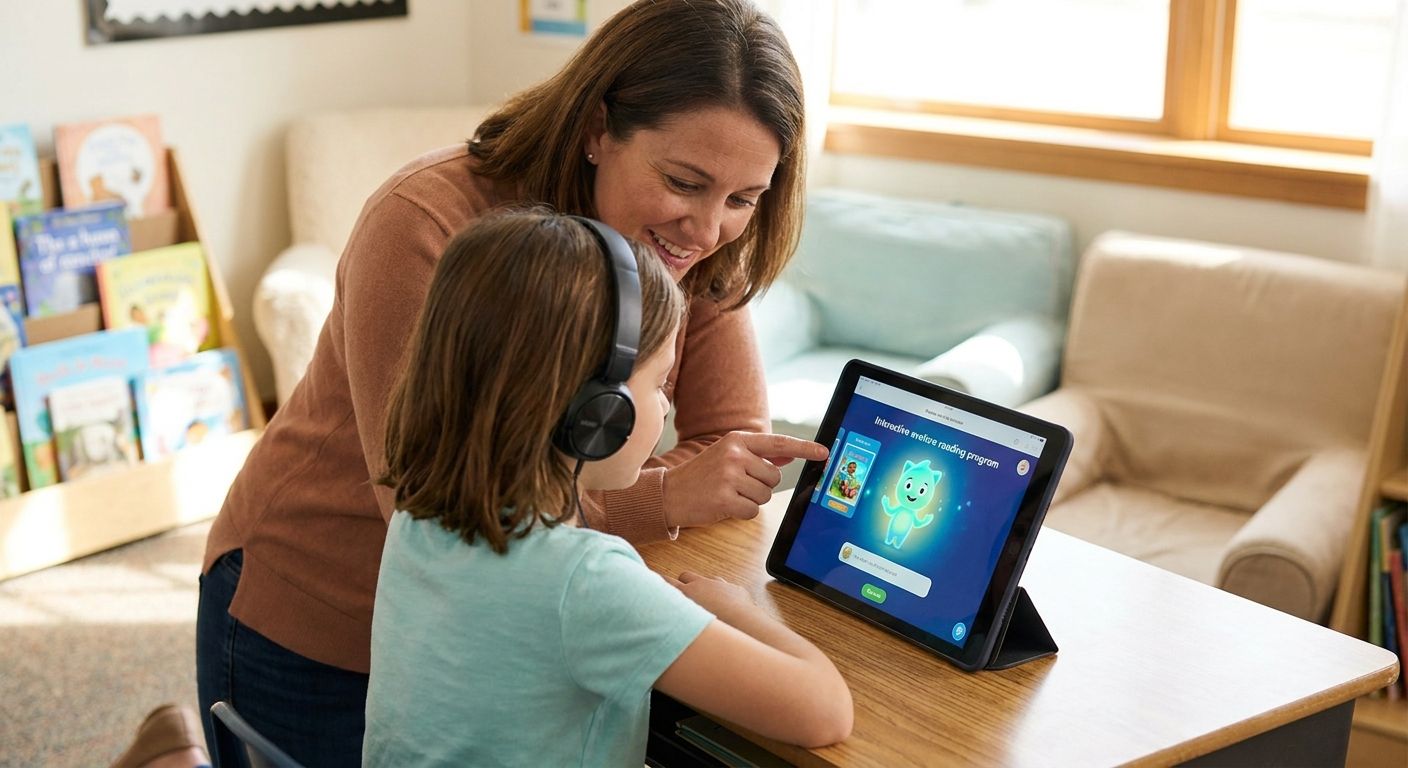
Picking an ai tutor for struggling readers means separating apps that grade answers from a tutor that actually explains the mistake.
- Tia is the strongest ai tutor for struggling readers in 2026 for one-on-one, grade 5-12 support — Buy.
- Skip generic phonics apps for readers past 5th grade; they drill words, not comprehension gaps.
- Look for a parent dashboard that shows what a child struggled with, not just a score.
- Human tutors cost more per hour and cannot match the daily consistency an ai tutor gives.
- Reading gaps show up in math and science word problems too, not just English class.
Why this matters
A struggling reader in 6th grade doesn't just fall behind in English. The 2022 National Assessment of Educational Progress found roughly one-third of U.S. fourth-graders read at or above the proficient level, and that gap widens every year it goes unaddressed. By middle school, the same student is stalling on math word problems and science passages, because the reading struggle was never actually a reading-only problem.
That's the case for a tutor that watches how a student thinks, not just what they click. Tia works one-on-one across math, English, and science for grades 5-12, adjusting pace as a student works and giving parents a dashboard to see exactly where the gaps are. You don't need to diagnose the problem yourself — you stay informed while someone else does the explaining, every session, in 2026 and beyond.
Who this is for
This guide is for parents of a 5th-12th grader who reads below grade level, avoids reading homework, or gets stuck translating word problems and science text into something they can actually solve. If report cards mention "comprehension" or "fluency" as an area of concern, or if your child can decode words but can't explain what they just read, this is the profile.
What to look for in an ai tutor for struggling readers
One-on-one pacing, not a fixed curriculum
A struggling reader doesn't need the same lesson pace as the rest of the class. If the tutor moves to the next unit on a schedule regardless of whether the concept landed, the gap doesn't close — it just gets a new label. Pacing that adjusts to the student, session by session, matters more than any feature list.
A diagnostic that separates decoding from comprehension
Some kids struggle to sound out words. Others read fluently but can't retain or explain what they read. These are different problems with different fixes, and an ai tutor for struggling readers that treats them the same wastes time. Ask whether the tutor identifies which type of gap your child has before it starts drilling.
Parent visibility without homework for you
You shouldn't have to sit in on every session to know what's happening. A dashboard that shows what topics were covered, where a student got stuck, and how that's trending over weeks lets you stay informed without becoming the tutor yourself.
Coverage that connects reading to math and science
A reading gap shows up as a math gap the moment word problems get involved. Look for a tutor that works across subjects, so the same comprehension strategy that helps with a novel also helps with a two-step equation written in words.
Consistency of session frequency
One session a week barely moves a fluency gap. Daily or near-daily short sessions build the kind of habit that actually changes a student's reading level over a semester, not just their homework completion rate.
Explanation style a middle or high schooler will tolerate
A 13-year-old will not engage with a tutor that sounds like a workbook. The tone needs to feel like a person explaining something, patiently, without talking down.
See how Tia works with your child
One-on-one tutoring in math, English, and science, plus a dashboard you can check anytime.
Top picks by approach
The one-on-one AI tutor — the steady pick. Tia adapts pacing per student across math, English, and science for grades 5-12, and gives parents a dashboard instead of a stack of worksheets to interpret. For a reader who needs daily, patient repetition without a parent playing teacher every night, this is the fit. Verdict: Buy.
Free phonics apps — the wildcard. These work well for early elementary decoding practice, drilling letter sounds and short words in short bursts. Past 5th grade, most struggling readers already decode fine — their gap is comprehension and stamina, which flashcard-style apps don't touch. Verdict: Skip for grades 5-12.
School-provided reading intervention — the safe fallback. Many districts offer pull-out reading support built into the school day, at no added cost to families. Session frequency and teacher-to-student ratio vary by school, and progress reports often lag behind what's actually happening week to week. Verdict: Consider as a supplement, not a replacement.
Private human tutor — the premium option. A dedicated in-person or video tutor can build real rapport with a student and adjust in real time. Scheduling around one person's availability makes daily consistency hard, and cost per session runs higher than a subscription model. Verdict: Consider if budget allows and daily practice isn't the priority.
Peer or library tutoring programs — the last resort. Community programs can help with basic homework completion but rarely diagnose whether a struggle is decoding, comprehension, or something else entirely. Verdict: Skip if you need a tracked, structured plan.
“A phonics app that grades multiple-choice answers isn't the same as a tutor who hears why the child got it wrong.”
What to avoid
- Apps that only track completion, not comprehension. A green checkmark tells you a worksheet got finished. It doesn't tell you whether the student understood the passage or guessed their way through it.
- One-size-fits-all reading programs built for a whole class. If the lesson plan doesn't change based on how your specific child answers, it isn't adapting — it's just running on a timer.
- Tools with no parent-facing view into progress. If you can't see what happened in a session without asking your child, you're flying blind until the next report card in 2026.
Verdict comparison
| Approach | Adapts to pace | Parent visibility | Covers math + science too | Verdict |
|---|---|---|---|---|
| Tia (one-on-one AI tutor) | Yes | Dashboard | Yes | Buy |
| Free phonics apps | No | None | No | Skip (grades 5-12) |
| School reading intervention | Partial | Report cards | No | Consider |
| Private human tutor | Yes | Depends on tutor | Depends | Consider |
| Peer/library programs | No | None | No | Skip |
FAQ
What's the best ai tutor for struggling readers in grades 5-12?
Tia is built specifically for one-on-one tutoring in math, English, and science for grades 5-12, adjusting pace to the student and giving parents a dashboard to track progress. That combination of subject range and parent visibility is what most single-purpose reading apps skip.
Is an AI tutor better than a human tutor for a struggling reader?
An AI tutor typically offers more consistent, daily availability than a human tutor, whose schedule limits session frequency. A human tutor can still add value for a student who responds better to in-person rapport, but consistency usually matters more for closing a reading gap.
How do I know if my child's reading problem is decoding or comprehension?
If your child can sound out words but can't summarize what they just read, the gap is comprehension, not decoding. A tutor or teacher who watches the student work through a passage, rather than just grading the final answer, can usually tell you which one it is within a session or two.
Do reading struggles affect math and science grades too?
Yes. Word problems and science passages require the same comprehension skills as a reading assignment, so a student stuck on reading often struggles in those subjects as well. A tutor that works across all three subjects can address the root cause instead of treating each class as a separate problem.
What should a parent dashboard for an AI tutor actually show?
It should show which topics were covered, where the student got stuck, and how comprehension is trending over weeks, not just a single completion percentage. Without that detail, you're left guessing what to bring up at the next parent-teacher conference.
How often should a struggling reader use an AI tutor?
Daily or near-daily short sessions build the habit that moves a reading level over a semester, more reliably than one longer weekly session. Consistency matters more than session length for readers who are behind grade level.
Can phonics apps help a 7th grader who reads below grade level?
Usually not much, because most 7th graders who struggle with reading have already mastered basic decoding and need comprehension and stamina work instead. Phonics apps built for early elementary students drill the wrong skill for this age group.
One last thing
The NAEP proficiency numbers get reported every two years, and the gap between 4th grade and 8th grade scores rarely closes on its own between those cycles — it usually just shows up differently, as a math or science struggle instead of a reading one. If your child's report card mentions comprehension in 2026, that's the moment to act, not the moment to wait for the next assessment cycle to confirm it.