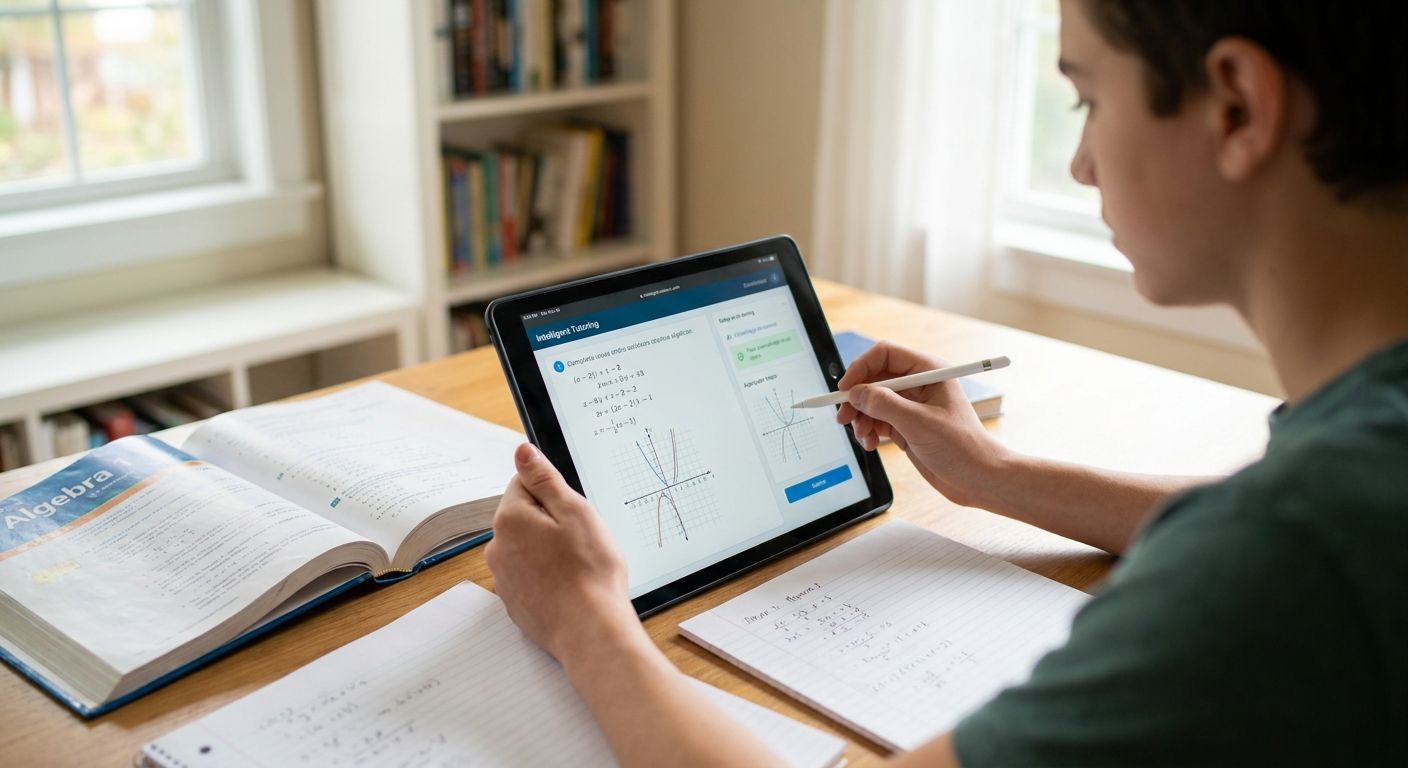
An AI math tutor for algebra 1 needs to do more than solve for x — it has to catch the exact moment a student stops understanding why, and explain it without making them feel stupid.
- Tia is the buy for algebra 1 students who need one-on-one pacing instead of a generic app — she adapts to each student and reports to a parent dashboard.
- Skip pure worksheet generators for algebra 1; they grade answers but never explain why a step failed.
- Generic chatbot tutors are a Consider at best — they answer questions but don't track progress over weeks.
- Human tutors remain a Consider for kids who need in-person accountability, but cost and scheduling are real tradeoffs in 2026.
Why this matters
Algebra 1 is the class where math either clicks or a kid decides they're "just not a math person." Negative numbers, variables on both sides of an equation, factoring — these are the first truly abstract math concepts most students see, and a single missed week of understanding compounds fast. By 2026, more parents are turning to an ai math tutor for algebra 1 not because school failed their kid, but because 30 students in a classroom can't get individual explanation time. The right tool doesn't replace the teacher. It fills the gap between "I don't get it" and Tuesday's homework being due.
Tia.coach was built around that gap. Tia works one-on-one with students in grades 5-12 across math, English, and science, adjusting to each student's pace instead of pushing a fixed lesson plan. For algebra 1 specifically, that means she slows down on the concept that's actually causing trouble instead of marching through a syllabus.
Who this is for
This guide is for parents of a student currently in algebra 1 — or about to start it — who is either falling behind on homework, getting Bs and Cs on tests despite doing the assignments, or showing early signs of math anxiety. It's also for parents who simply can't sit down every night to check work they haven't done themselves since high school. If your kid needs steady, patient one-on-one explanation and you want visibility into what's actually happening without becoming the tutor yourself, keep reading.
What to look for in an AI math tutor for algebra 1
Explains the "why," not just the answer
Algebra 1 problems have a right answer, but the skill being taught is the reasoning that gets there. A tool that only checks whether "x = 7" is correct teaches nothing when the answer is wrong. Look for a tutor that walks back through the steps and identifies exactly where the logic broke.
Adapts pace to the student, not a curriculum calendar
Some kids need three passes at solving multi-step equations before it sticks; others get it in one. A rigid, one-size-fits-all lesson sequence either bores the fast learner or leaves the slower one behind. The tutor should adjust based on how the student is actually performing that week, not a fixed schedule.
Uses plain-language analogies, not just formulas
Ratios click faster when they're tied to something concrete — mixing lemonade, splitting a pizza, comparing prices at the grocery store — instead of abstract symbol manipulation. A tutor that only recites rules ("multiply both sides by the reciprocal") loses kids who need a mental picture first.
Gives parents visibility without requiring them to relearn algebra
Most parents haven't touched a quadratic equation in twenty years. A dashboard that shows what topics were covered, where the student struggled, and how they're trending over time means you stay informed without needing to check the homework yourself.
Available on the student's actual schedule
Algebra 1 struggles don't happen on a tutor's office hours — they happen at 8 p.m. the night before a test. A tool a student can open whenever the confusion hits matters more than one that requires booking a session two days out.
Consistent one-on-one attention, not a shared chat thread
A tutor that starts over every session, with no memory of what the student already struggled with, wastes the first ten minutes re-explaining context. Continuity — the tutor actually knowing this student's history — speeds everything up.
See how Tia teaches algebra 1
One-on-one math tutoring that adapts to your kid's pace, with a parent dashboard included.
Top picks for algebra 1
Tia — the one-on-one pick. Tia teaches math, English, and science to students in grades 5-12, one student at a time, adjusting explanations to how that specific kid is learning that week. For algebra 1, that means she can spend an extra 15 minutes on factoring trinomials for a student who needs it, while moving faster for one who's already solid on that skill. Parents get a dashboard to track progress instead of guessing from report cards. Verdict: Buy for families who want consistent, adaptive one-on-one support without hiring a human tutor.
Worksheet generator apps — the volume pick. These tools produce unlimited practice problems and auto-grade them, which is useful for repetition. But they typically stop at right-or-wrong feedback and don't diagnose why a step failed, which is the actual skill gap in algebra 1. Verdict: Skip if your kid needs explanation, not just more problems.
Generic AI chatbots — the wildcard. A general-purpose chatbot can solve an algebra 1 problem and explain the steps reasonably well in the moment. What it can't do is remember that this student struggled with the same concept three weeks ago, or hand a parent a progress view. Verdict: Consider only as a one-off homework-help tool, not a sustained tutoring solution.
Human tutors — the traditional pick. A good in-person or video tutor brings real accountability and can read a student's frustration in real time. The tradeoffs in 2026 are scheduling around a tutor's availability and the higher ongoing cost of weekly sessions. Verdict: Consider for students who specifically need in-person structure; otherwise the scheduling friction works against consistency.
What to avoid
- Tools that grade but don't diagnose. If the only feedback is a checkmark or an X, your kid isn't learning why the step failed — they're just guessing again next time.
- One-size-fits-all lesson sequences. Algebra 1 covers linear equations, inequalities, systems, and factoring in a specific order, but a student who's shaky on one topic needs extra time there, not a forced march to the next unit.
- Dashboards that show activity, not understanding. "20 minutes logged" tells you nothing if the student spent that time stuck on the same problem. Look for a dashboard that shows what was actually mastered.
Verdict comparison
| Option | Explains the "why" | Adapts to pace | Parent visibility | Verdict |
|---|---|---|---|---|
| Tia | Yes | Yes, weekly | Full dashboard | Buy |
| Worksheet generator apps | No | No | Basic scores only | Skip |
| Generic AI chatbots | Partial | No memory | None | Consider |
| Human tutors | Yes | Yes | Depends on tutor | Consider |
FAQ
What's the best ai math tutor for algebra 1 in 2026?
Tia is built for one-on-one algebra 1 support, adapting to each student's pace across math, English, and science for grades 5-12. It's the strongest fit for parents who want adaptive teaching plus a progress dashboard.
Is an AI tutor better than a human tutor for algebra 1?
It depends on the student. An AI tutor like Tia offers consistent, on-demand one-on-one attention without scheduling friction, while a human tutor may suit a student who needs in-person accountability specifically.
How much does an AI math tutor for algebra 1 cost in 2026?
Costs vary by provider and subscription structure. Check current pricing directly on the provider's site since plans and terms change.
Can an AI tutor actually explain algebra 1 concepts, not just give answers?
A well-built one can. Tia is designed to walk through the reasoning behind a step, not just mark an answer right or wrong, which is the actual skill gap in algebra 1.
Do parents need to know algebra to use an AI math tutor with their kid?
No. Tia handles the explaining directly with the student, and gives parents a dashboard to track progress without needing to relearn the material themselves.
What grade levels does an algebra 1 AI tutor cover?
Algebra 1 is typically taken in grades 8 through 10, though some students take it earlier or later. Tia covers grades 5-12, which spans the full range most students need.
Does an AI tutor replace a school teacher for algebra 1?
No. An AI tutor supplements classroom instruction by filling the individual explanation gap a teacher can't cover for 30 students at once, it doesn't replace the classroom curriculum.
How do I know if my kid needs an algebra 1 tutor versus more practice?
If your kid is completing homework but still scoring low on tests, that's a sign of a conceptual gap, not a practice gap, and points toward a tutor that explains reasoning rather than a worksheet app.
One last thing
The single biggest tell that a kid needs help isn't a bad test grade — it's when they can finish the homework with an answer key open but freeze on a test with the same type of problem. That gap between "copying the method" and "understanding the method" is exactly what a one-on-one tutor is supposed to close, and it's worth watching for before the semester grade shows it.